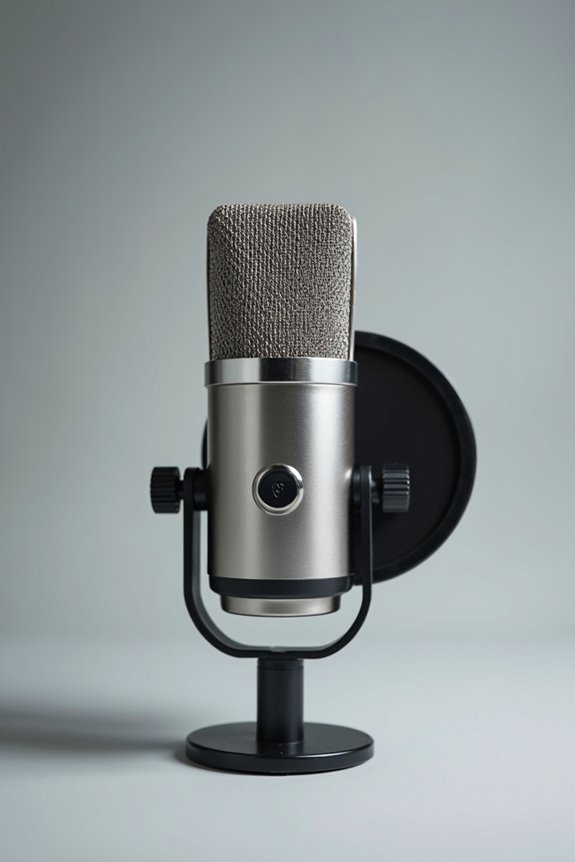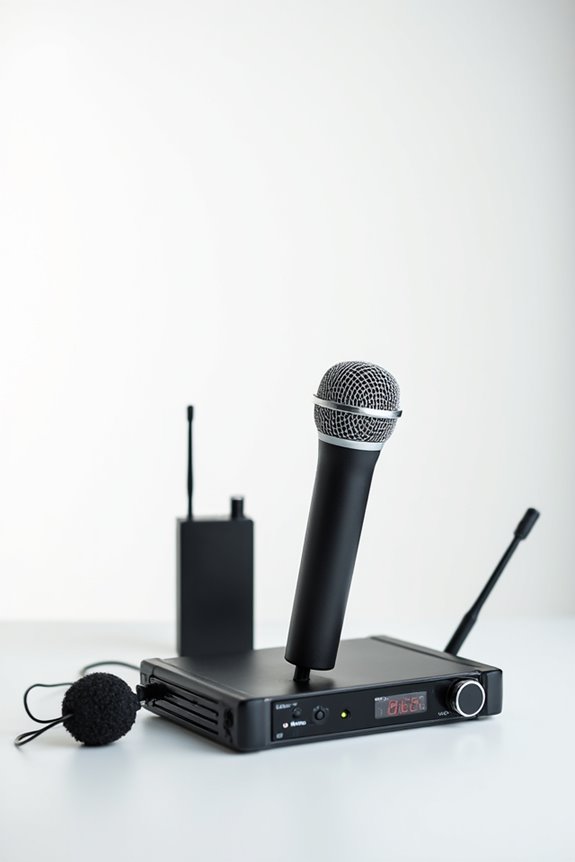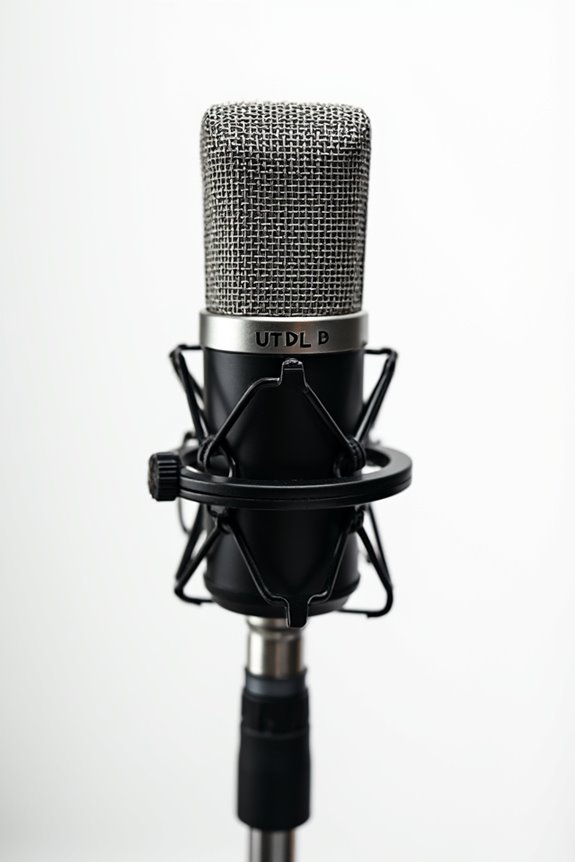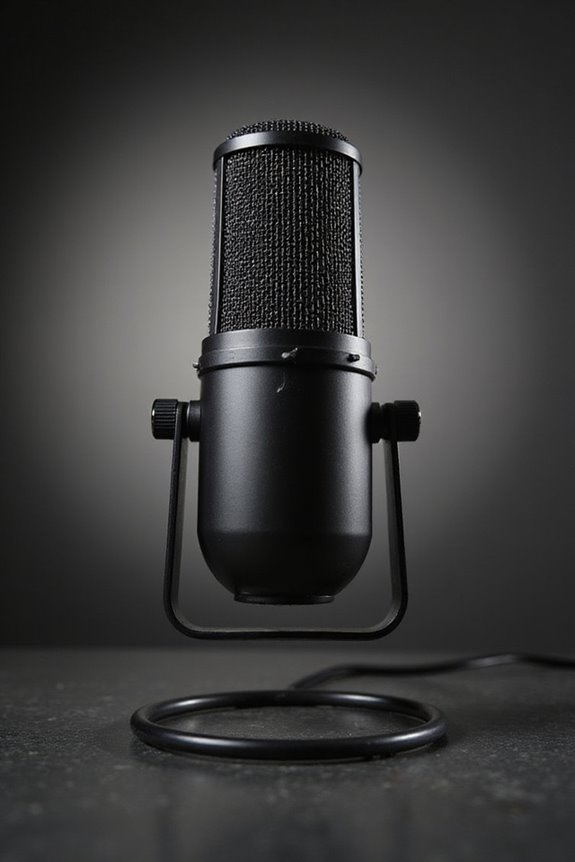
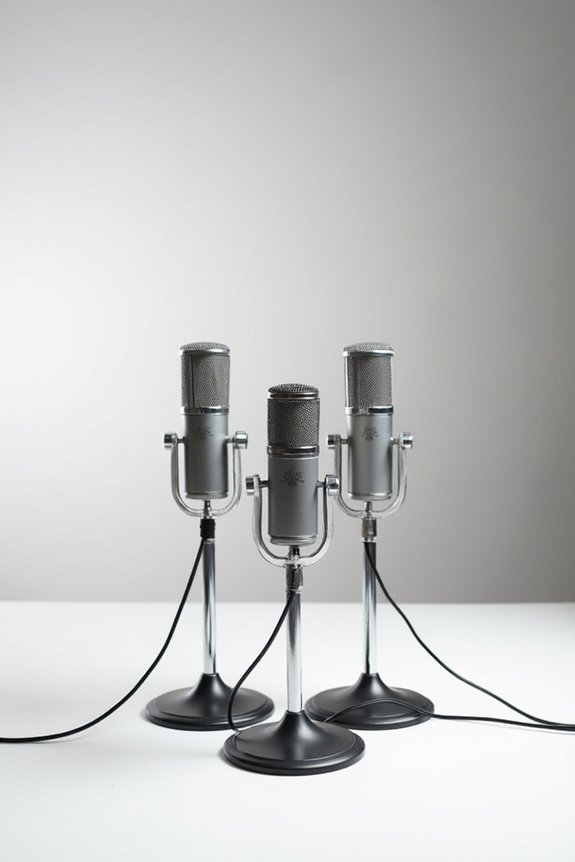

When you’re looking for the right microphone for your acoustic guitar, we often recommend a few options based on your needs! Dynamic mics like the Shure SM57 are great for live settings due to their durability. For studio use, consider a condenser mic, like the Shure SM81, which captures those sweet, detailed tones well. Remember to pay attention to features like sensitivity and polar patterns to optimize your sound! Stick around—there’s more mic magic to explore! 🎸
Key Takeaways
- Dynamic Microphones like Shure SM57 are ideal for live settings due to their durability and ability to handle high sound pressure levels.
- Condenser Microphones, especially small-diaphragm types like Shure SM81, are excellent for home studios to capture detailed tones.
- Multi-pattern Microphones, such as AKG C414 XLS, provide flexibility in recording environments and enhance acoustic guitar sound quality.
- Consider Directionality: Cardioid patterns reduce background noise, making them preferable for live performances and focusing on the guitar’s sound.
- Experiment with Placement: Mic positioning around the 12th fret or the “Money Spot” can significantly improve the tonal quality of recordings.
Types of Microphones for Acoustic Guitar
You may be interested


When it comes to choosing a microphone for your acoustic guitar, it’s not just about picking the first shiny thing you see! 🎤 There are several types of microphones available, each offering unique benefits for capturing that beautiful sound.
Recommended Products

Three distinct tube microphones at the flip of a switch. FORWARD is bold, present and modern, but never harsh. NEUTRAL is smooth and earthy with a natural balancing of sibilant sounds. GENTLE is dark and sultry with a warm vintage feel, ideal for taming bright or abrasive sound sources.

2 x C414 XLS Sonically Matched Pair - Engineered for highest linearity and neutral sound for beautifully detailed recording of vocals and any acoustic instrument

Two XLR mic/line inputs with phantom power for condenser microphones
1. Dynamic Microphones
These are rugged and handle loud volumes. Think Shure SM57, often placed around the 12th fret. They’re great for live settings!
2. Condenser Microphones
Preferred for studio use, they capture every tonal detail. Models like the Shure KSM44A give that rich sound we all love, and high sensitivity and noise reduction features enhance audio clarity.
3. Ribbon Microphones
These provide a smooth, warm tone, but handle them carefully!
4. Multi-Pattern Microphones
Flexible and versatile, they adapt to different acoustic guitar setups with ease!
Each has its own microphone characteristics to suit your needs. Let’s explore your options!
Popular Microphone Models by Price Range
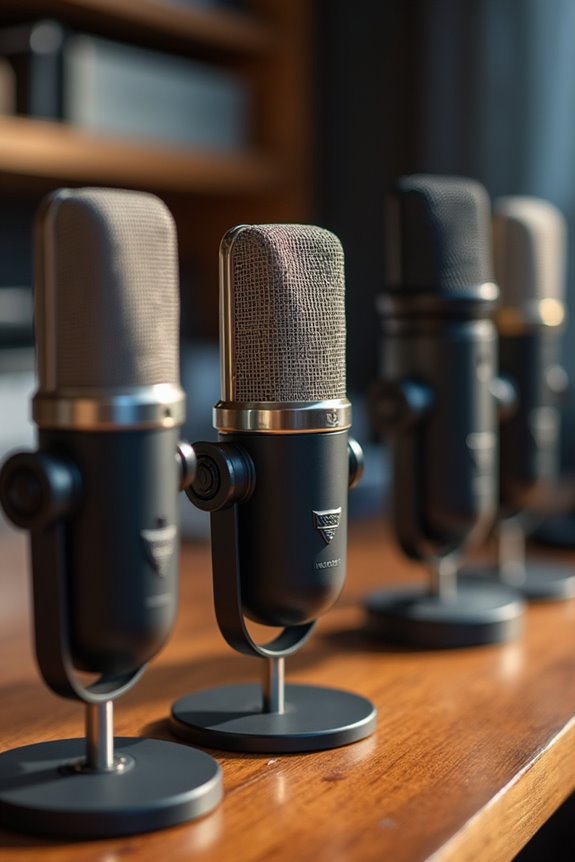
Budget Microphones (Under $200)
- Shure SM57: Great for live settings at around $100.
- Rode NT1-A: Condenser magic priced between $150-$200.
- Audio-Technica AT2020: Affordable and decent, near $100.
Mid-Range Microphones ($200 – $500)
- Shure SM81: Excellent at around $350.
- Rode NT2-A: Versatile with low noise, about $350.
High-End Microphones ($500 – $1000)
– Neumann TLM 102: Fantastic quality at $700.
With this price comparison, you’ll find something perfect for your sound! 🎶 Additionally, considering the directionality of microphones can greatly enhance your recording experience.
Recommended Products

Available as a single mic or as a stereo pair, the AT5045 is Audio-Technica’s premier condenser instrument microphone, offering the performance of a large-diaphragm, side-address condenser in a convenient, stick-type body. In fact, despite the space limitations imposed by its housing, the AT5045 boasts Audio-Technica’s largest single diaphragm. The instrument microphone’s circuitry has been honed to the essentials, allowing the AT5045 to achieve an unprecedented dynamic range that’s one of the widest of any microphone on the market. Every AT5045 is hand assembled and individually inspected for 100% quality control. Each microphone is enclosed in an elegant housing of aluminum and brass with a high-quality gray finish for durability and low reflectivity. Discrete components have been selected for optimized performance. The circuitry and capsule assembly are mounted as a single block within a floating internal shock mount, effectively decoupling the capsule from the microphone body for excellent vibration isolation. In fact, every aspect of the microphone has been carefully considered to minimize any negative effects on the audio signal. The AT5045 instrument mic comes with Audio-Technica’s innovative AT8481 isolation clamp, an AT8165 windscreen and a protective carrying case that holds a single AT5045 microphone or a stereo pair of AT5045 microphones. Available as a single microphone (AT5045) or as a stereo pair (AT5045P). Features: Audio-Technica’s premier studio condenser instrument microphone Pure, realistic sound quality for overheads, percussion, acoustic guitar, strings and other acoustic instruments Side-address, stick-design microphone with more diaphragm surface area than most traditional large diaphragm side-address microphones Discrete components carefully selected for optimized performance Transformer-coupled output is optimized to provide smooth sonic character Exceptionally low noise with high-SPL capability Hand built and inspected for 100% quality control Advanced internal shock mounting decouples the capsule from the microphone body Elegant, durable housing of aluminum and brass Innovative isolation clamp provides secure mounting, versatile positioning and effective dampening of unwanted mechanical noise Available as a single microphone (AT5045) or as a stereo pair (AT5045P) Custom hard-shell carrying case with die-cut foam compartments offers protection for one or two microphones Specifications: Element: Fixed-charge back plate, permanently polarized condenser Polar Pattern: Cardioid Frequency Response: 20 to 20000Hz Open Circuit Sensitivity: -35dB (17.7mV) re 1V at 1 Pa Impedance: 100Ohms Maximum Input Sound Level: 149dB SPL, 1kHz at 1% T.H.D. Noise: 8dB SPL Dynamic Range (typical): 141dB, 1kHz at Maximum SPL Signal-to-noise Ratio: 86dB, 1kHz at 1 Pa Phantom Power Requirements: 48V DC, 1.4mA typical Output Connector: Integral 3-pin XLRM-type Audio-Technica Case Style: R11 Dimensions (L x Dia.): 177 x 25mm / 6.97 x 0.98" (maximum body diameter) Weight: 197g / 6.95oz

Small-diaphragm Supercardioid Condenser Microphone with Clip Cable - Acoustic Guitar

WIRELESS FREQUENCY BAND SELECTION: Before purchasing, please ensure that the wireless frequency band you select works in your area (refer to Shure website for details > search Shure Wireless Frequency Finder).
Key Features and Specifications for Acoustic Guitar Mics
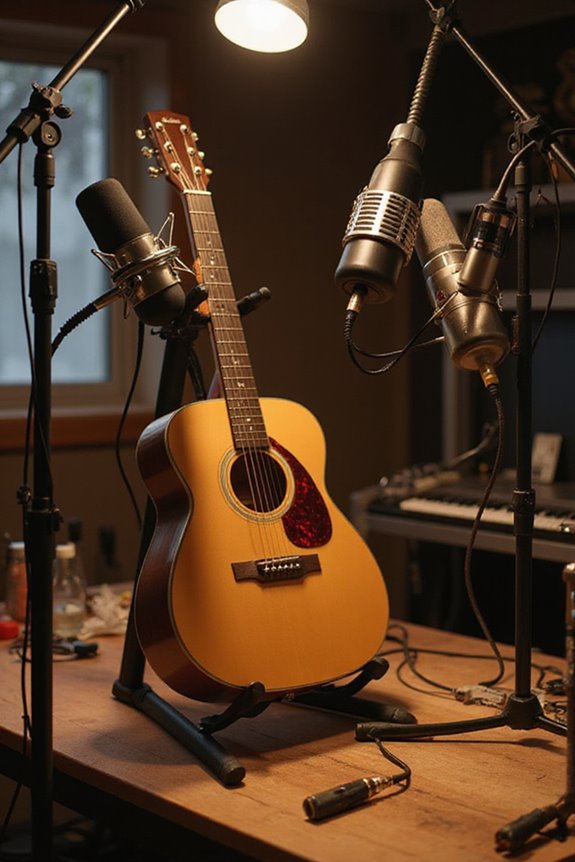
Choosing the right microphone for your acoustic guitar is like finding the perfect pair of shoes—it can make a world of difference! 🎸 In this section, we’ll break down the essential features and specifications for acoustic guitar mics, so you can hit the right notes both in the studio and on stage.
Microphone Sensitivity: Look for mics with around 15 mV/Pa sensitivity for detail.
Polar Pattern: Cardioid patterns are great to minimize background noise, while supercardioid offers even more off-axis rejection.
Diaphragm Size: Small-diaphragm condensers capture clear, detailed sound, while large-diaphragm mics add warmth.
Frequency Response: Aim for 20 Hz to 20 kHz to cover your guitar’s full tonal range.
With these specs in mind, you can find the mic that truly fits!
Recommended Products

Reissue of Vintage U 67 Microphone

Large-diaphragm Condenser Microphone

Variable large diaphragm microphone
Recording Techniques Involving Acoustic Guitar Mics
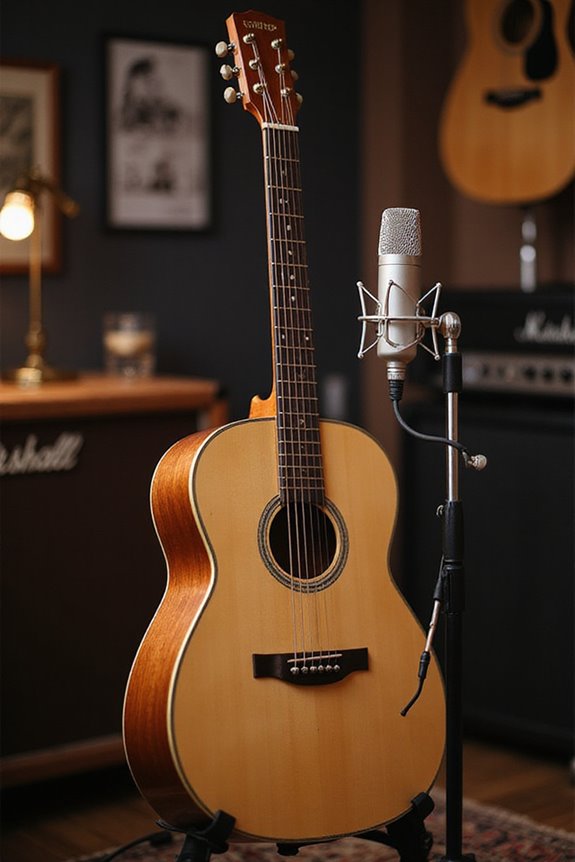
With the right microphone in hand, it’s time to talk about how to make the most of that gear! 🎤 We all want to capture the sweet sound of our acoustic guitars, so let’s explore some recording techniques and mic configurations. For those rich stereo vibes, try the XY technique with two mics angled at 90 degrees. The “money spot,” about 12 to 16 inches from the 12th fret, provides a balanced tone that’s just right! 😍 Don’t forget to check phase when using multiple mics to avoid any funky sounding recordings. Experiment with different placements, like one mic above the sound hole and another near the bridge, to find your perfect sound! Happy recording!
Performance Considerations for Acoustic Guitar Mics
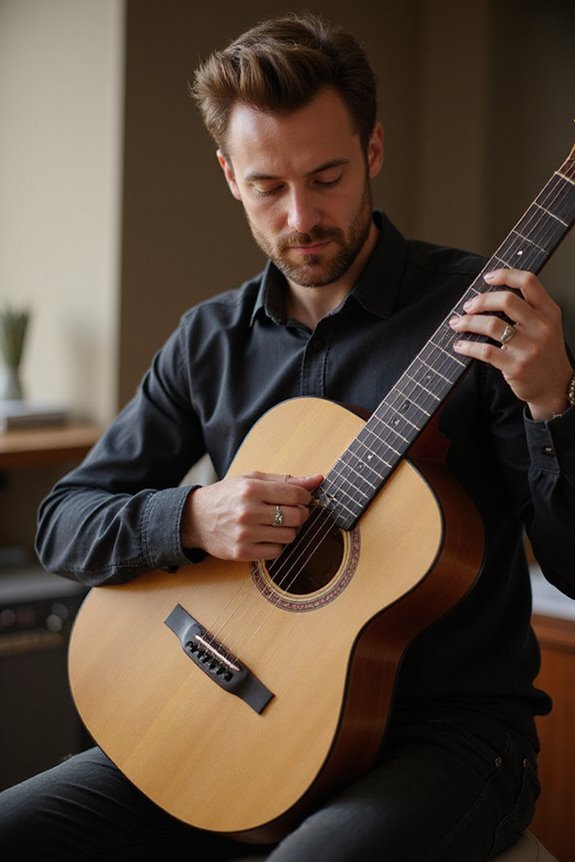
When we think about performance considerations for acoustic guitar mics, it’s all about blending artistry with the right gear! 🎸 Finding that perfect microphone means diving into details like frequency response and polar patterns. The mic’s sensitivity should accurately capture performance dynamics, so we hear every nuance of our playing—be it soft fingerpicking or bold strumming.
Omnidirectional mics offer a full and natural capture of our sound, while cardioids focus on isolating the guitar, reducing background noise. Consistent mic placement is key to avoiding tonal inconsistencies during our performance, and using mics with high transient response guarantees clarity in every note we play. Additionally, considering audio quality standards ensures that we’re achieving the best possible sound capture in our recordings. Let’s choose wisely for the best blend of our sound and the surrounding space!
Best Practices for Microphone Placement
Microphone placement is essential for capturing the full beauty of your acoustic guitar, and nailing it can make all the difference in your sound! 🎶 We recommend a distance of 12 to 16 inches from the 12th fret for that sweet spot—this placement helps us avoid the overwhelming bass that comes from sitting too close to the sound hole. By positioning the mic slightly above or below the bridge, we can enhance warmth and avoid shadowing. Don’t forget about microphone angles; angling slightly off-axis reduces unwanted acoustical reflections. Experimentation is key! Play around with these techniques, and you’ll find the perfect balance of distance effects that captures your guitar’s rich tones while keeping fret noise in check. Happy recording!
Combining Different Microphone Types
Combining different microphone types can elevate your acoustic guitar recordings to a whole new level! 🎸 By leveraging the unique strengths of each microphone, we can achieve a more balanced and rich sound. Let’s explore some microphone blending techniques that enhance tonal quality.
A small-diaphragm condenser captures bright details, while a large-diaphragm adds warmth. Pairing them can create a fuller tone. For a natural touch, we might add a ribbon mic to smoothen those sharp highs.
Don’t forget about dynamics! They can isolate sound well. By carefully positioning these mics—like placing a condenser near the 12th fret and a ribbon near the body—we can capture beautiful acoustic tones. This blend not only enriches our recordings, but also gives them character! Additionally, using microphones like AKG P170 ensures high sensitivity and a wide frequency range for comprehensive sound capture.
Recommendations for Home Studios vs. Live Performances
While finding the perfect microphone for your acoustic guitar can feel like searching for a needle in a haystack, it’s essential to contemplate the specific needs of your home studio versus a live performance.
Recommended Products

Demo Lg Condenser Tube Mic w/PS

Stereo Pair Series 180 Small-diaphragm Cardioid Condenser Microphones in Wooden Case - Nickel

Large-diaphragm Cardioid Condenser Mic with K 47 Capsule
Home Studio
In our cozy setups, we crave a microphone that captures the nuanced, detailed tones of our guitars. Small-diaphragm condensers like the Shure SM81 ($350) excel here! They deliver natural sound, while budget options like the Line Audio CM4 ($150) are also fantastic alternatives. Additionally, microphones with a cardioid pickup pattern are ideal for isolating the guitar sound and minimizing background noise.
Live Performance
When we hit the stage, durability is key! Dynamic mics like the Shure SM57 ($100) handle the rough and tumble, plus they’re budget-friendly. Don’t forget about cardioid patterns to keep stage noise at bay! 🎶
With the right mic, our music shines, whether at home or under the spotlight!
Noteworthy Microphones to Consider
Small Diaphragm Condensors: The Shure SM81 excels with its flat frequency response, perfect for capturing shimmer. The Rode NT5 pair offers warm, crisp sound, making it versatile. Neumann KM 184 delivers a transparent tone, while the AKG C451 B is known for clarity in studio settings. For a budget-friendly choice, check out the Audio Technica AT2035!
Large Diaphragm Condensers: The Neumann U 87 Ai is premium for rich detail. AKG C414 XLS has multiple polar patterns, enhancing your recordings.
Dynamic Mics: The Shure SM57 excels in live situations, whereas the Beyerdynamic M 160 ribbon offers warmth.
Choose wisely, and let your guitar’s voice shine! 🎸
Recommended Products

Requires +48V phantom power

Large-diaphragm FET Condenser Microphone with Cardioid Interchangeable Capsule

𝗘𝗻𝗴𝗶𝗻𝗲𝗲𝗿𝗲𝗱 𝘄𝗶𝘁𝗵 𝗥𝘂𝗽𝗲𝗿𝘁 𝗡𝗲𝘃𝗲 – Featuring the world’s smallest gold-sputtered diaphragm and a full-scale custom transformer, the RN17 small diaphragm condenser microphone delivers ultra-fast transient accuracy, full low-end authority, and clarity across the entire frequency spectrum
Frequently Asked Questions
What Is the Ideal Distance Between the Mic and Acoustic Guitar?
When considering mic distance for acoustic guitar, we’re aiming for ideal microphone placement. Keeping about 8-12 inches typically enhances sound quality, balancing direct sound and room tone beautifully. Experimenting helps us achieve our desired results together.
Can I Use the Same Mic for Vocals and Guitar?
Absolutely, we can use the same mic for both vocals and guitar. With proper placement, we’ll capture vocal clarity and acoustic resonance, making our recordings rich and inviting. Let’s explore the best options together!
How Do I Prevent Feedback When Using a Microphone?
When we set up for our last jam, adjusting mic placement helped minimize feedback types. By angling the mic off-axis, we noticed a clearer sound. Let’s keep experimenting together to perfect our setup and avoid feedback!
What Accessories Should I Consider for Microphone Setup?
When setting up our microphones, we should consider using sturdy microphone stands for stability and pop filters to eliminate unwanted noises. These accessories enhance our sound quality, making our sessions more enjoyable and professional.
How Can I Maintain My Microphones for Longevity?
To guarantee our microphones last, we should follow proper microphone cleaning routines and adhere to storage tips. Regular maintenance will keep them performing well, letting us enjoy our sessions without worries about wear or damage.