
When choosing a sample rate for your audio interface, we recommend starting with 44.1 kHz for music or 48 kHz for film. These rates balance quality and file size beautifully! Higher rates, like 96 kHz or 192 kHz, can improve clarity but increase storage needs. Remember, matching the sample rate to your project guarantees smoother workflows. Got specific project requirements? We can help you find the perfect fit for your audio needs! 🎶
Key Takeaways
- Use 44.1 kHz for CD-quality sound and most streaming platforms, ensuring compatibility.
- Opt for 48 kHz when working on film and video projects for optimal audio performance.
- Higher sample rates like 96 kHz are better for professional recordings but increase file sizes significantly.
- Consider your storage capacity and CPU load; 48 kHz is a good compromise between quality and resource usage.
- Ensure your audio interface supports the chosen sample rate to maintain workflow efficiency and audio integrity.
Understanding Sample Rates
You may be interested
So, what’s a sample rate? In short, it’s how many times per second we capture an analog audio signal during conversion. For instance, 44.1 kHz is our go-to for CDs, capturing frequencies up to 22.05 kHz, covering the entire human hearing range. Higher rates, like 96 kHz, let us explore frequencies beyond our perception but can lead to larger files and more processing tasks.
Why It Matters
Choosing the right sample rate is vital! It prevents distortion, enhances audio quality, and guarantees your recordings truly resonate. Remember, with great power comes great responsibility—so choose wisely! 🎶 Additionally, opting for a sample rate of 24-bit/192kHz can significantly improve your recording clarity and dynamic range.
The Nyquist Theorem Explained

When it comes to digital audio, understanding the Nyquist Theorem is crucial for any aspiring audio engineer or music enthusiast. We can’t overstate the Nyquist importance! Basically, it states that our sampling rate must be at least twice the highest frequency we want to capture. This guarantees signal fidelity and prevents issues like aliasing, which can distort our beautiful audio. If we sample below this rate, higher frequencies can get folded into lower ones, creating a hot mess of sound! 🎶 To avoid this, anti-aliasing filters help limit bandwidth before sampling. A common example is the 44.1 kHz sample rate for CDs, allowing us to enjoy crystal-clear sound. So, let’s keep those frequencies intact and our audio pristine! 🎧
Industry Standards for Sample Rates

Understanding sample rates is key to mastering audio production, and it ties right back to the Nyquist Theorem we just covered. When we think about industry standards, 44.1 kHz reigns supreme for CDs and most streaming platforms, while 48 kHz is the go-to for film and video. This sample rate comparison helps us align our projects with audio format specifications.
For those of you diving into professional recording, higher rates like 96 kHz and 192 kHz often come into play but are typically downsampled for distribution. So, it’s essential to choose a sample rate that fits your project’s final medium, whether it’s music or audiovisual content. Remember, audio quality specifications are crucial for achieving the best sound in your recordings. Workflow is key in our audio adventures!
Recommended Products

with 16 XLR Microphone Inputs

64-channel Dante Option Card for dLive C-Class S-Class Surfaces Mix Racks

Rode Rodecaster Pro II is a fully integrated audio production studio for podcasters, streamers, musicians and content creators
Benefits of Higher Sample Rates

While it might seem like a small detail, choosing a higher sample rate can release major benefits for your audio projects! 😊 One of the most significant advantages is reduced latency, which is essential for real-time applications like live performances or recording sessions. By moving from 44.1 kHz to 88.2 kHz, we can cut latency from about 12.2 ms to 9.2 ms!
Additionally, higher sample rates improve filter performance, helping us avoid harsh artifacts. They also enhance DSP handling, providing cleaner effects with less aliasing. Plus, capturing ultrasonic frequencies can subtly boost audio realism, and a wider dynamic range means we can catch those quiet moments without distortion. To sum it up, higher sample rates truly elevate our audio game! 🎶 Furthermore, using interfaces like the Focusrite Scarlett Solo can maximize the benefits of these higher sample rates with their advanced mic pre-amps.
Recommended Products

SONY USA AUTHORIZED - Includes Full SONY USA WARRANTY | Introducing the Sony Alpha a7S III - a new milestone in sensitivity, speed and image supremacy.

SONY USA AUTHORIZED - Includes Full SONY USA WARRANTY | Introducing the Sony Alpha a7S III - a new milestone in sensitivity, speed and image supremacy.

SONY USA AUTHORIZED - Includes Full SONY USA WARRANTY | Introducing the Sony Alpha a7S III - a new milestone in sensitivity, speed and image supremacy.
Impact on Audio Quality

As we explore the impact of sample rates on audio quality, it’s fascinating to see how these technical details shape our listening experience! 🎧 One of the key concepts to grasp is the relationship between sample rate and frequency response. Higher sample rates, like 88.2 kHz or 96 kHz, can capture more detail, especially in ultrasonic frequencies, but let’s be real—most of us can’t hear above 20 kHz anyway. While this can improve audio fidelity, the benefits might not be noticeable in standard listening environments. Plus, higher rates can push aliasing distortion out of our auditory perception range. Ultimately, it’s about finding the right balance for your setup, ensuring clarity without sacrificing system performance, which is key! Additionally, choosing an audio interface that supports high audio quality is essential for maximizing your recording experience.
Practical Recommendations for Different Media
When it comes to selecting the right sample rate for different media, we’ve got some straightforward recommendations to help you get the best results! 🎶 For music production, 44.1 kHz at 24-bit is your go-to choice, aligning perfectly with CD quality and ensuring you capture all the nuances of your sound. If you’re streaming, consider 48 kHz for compatibility with platforms and devices. For video projects, stick to 48 kHz to sync audio smoothly with visuals. If you’re diving into sound design, higher rates like 96 kHz offer benefits for effects and fidelity. Additionally, ensure your interface supports 24-bit/192kHz recording capability to maximize audio quality. With these practical recommendations, you’ll nail your recording techniques and audio formats every time! So let’s get started, shall we?
Recommended Products

Mix and record through AAX DSP plugins with rock-solid sub-1 ms latency monitoring

Classic ISA mic preamp design featuring Lundahl LL1538 input transformer

For Recording Studios and Touring
Technical Limitations of High Sample Rates
Few things can spark a debate quite like high sample rates in audio production! 🎶 While there’s a common belief that higher sample rates automatically mean better sound quality, the reality is a bit more nuanced. Higher rates do shift the Nyquist frequency above what we can hear, allowing gentler filter designs that improve audio fidelity. But let’s not forget about aliasing effects: if our filters aren’t up to snuff, we might introduce distortion instead of clarity. Plus, processing limitations emerge with more data, making our systems work harder. So, while chasing high sample rates sounds tempting, we need to weigh those potential benefits against challenges like ringing and phase shifts that can sneak into our otherwise pristine audio!
Managing File Size and CPU Load
Managing file size and CPU load is essential for audio production, especially if we want to maintain a smooth workflow. 🎧 While higher sample rates promise better resolution, they also bring hefty file sizes that can fill up storage quickly. Recording at 44.1 kHz produces a manageable 22 MB for 20 seconds of audio, but push to 96 kHz, and those files could balloon!
To balance file management and resource allocation, we often recommend 48 kHz as a sweet spot: decent quality without taxing your system too much. Remember, larger files can slow down your editing or require more backups, so it’s vital to know your project’s needs. Using an audio interface with low latency can also enhance your recording experience, keeping it smooth and efficient. Let’s keep our sessions efficient and our creativity flowing!
Recommended Products
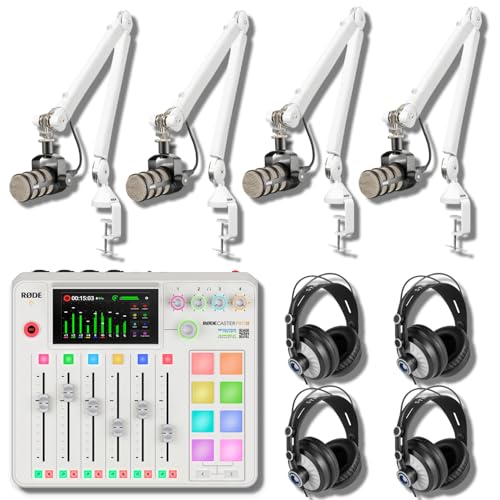
BROADCAST 4-HOST PODCAST STUDIO IN ONE COLOR-MATCHED BOX — CONSOLE, FOUR MICS, FOUR BOOM ARMS, FOUR HEADPHONES, FOUR CABLES, ONE MEMORY CARD: The Rode RODECaster Pro II (White) 9-channel production console pairs with 4 Rode PodMic dynamic mics, 4 Rode PSA1+ White boom arms, 4 StreamEye Cans50 headphones, 4 ten-foot balanced XLR cables, and a 32GB microSDHC card. Four channel strips with APHEX DSP. Four high-power headphone outputs.

BROADCAST 4-HOST PODCAST STUDIO IN ONE BOX — CONSOLE, FOUR MICS, FOUR BOOM ARMS, FOUR HEADPHONES: Running a 4-host podcast needs more than a console alone — you need matching mics for every host, a way to position each mic off the desk, closed-back monitoring per host, and the cables to wire it. This bundle pairs the Rode RODECaster Pro II 9-channel console with 4 Zoom ZDM-1 Podcast Mic Packs and 4 StreamEye BOOMARM1 desktop boom arms. Multi-host podcasters, panel-show producers, live-stream roundtable hosts, and broadcast interview shows — plug in and start recording today.

TABLETOP 4-HOST PODCAST STUDIO IN ONE BOX — CONSOLE, FOUR MICS, FOUR TRIPODS, FOUR HEADPHONES: Recording four hosts around a single table needs more than a console alone — you need matching mics for every host, a way to position each mic at speaking distance, closed-back monitoring per host, and the cables to wire it. This bundle pairs the Rode RODECaster Pro II 9-channel console with 4 Zoom ZDM-1 Podcast Mic Packs. Multi-host podcasters, panel-show producers, travel podcast crews, and broadcast roundtable hosts — set up the table, plug in, and start recording today.
Client and Industry Requirements
As we navigate the complexities of audio production, understanding client and industry requirements is key to delivering high-quality results. Different projects come with distinct sample rate expectations! For instance, 44.1 kHz is the gold standard for audio CDs, while broadcast and film often stick with 48 kHz. If you’re diving into game audio or virtual reality, clients might request higher rates like 96 kHz for rich sound design. It’s vital to communicate these requirements upfront to avoid hiccups later on. Remember—matching your project’s sample rate to client specifications guarantees smooth workflows and audio integrity. Plus, staying in line with industry standards keeps everyone happy! So, let’s make certain we’re all on the same frequency! 🎶
Selecting the Right Sample Rate for Your Needs
How do we choose the right sample rate for our audio projects? First, we need to evaluate audio interface compatibility and what we’re aiming for. If we’re recording music, sticking to 44.1 kHz might be our best bet for CD-quality sound. For film or video, 48 kHz is the standard we often use!
Next, let’s think about our personal workflow evaluations. Higher sample rates like 96 kHz sound tempting but can eat up storage and processing power. For most of us, recording at 48 kHz and downsampling to 44.1 kHz keeps things simple and efficient. Plus, consistency throughout our project is key, avoiding pesky resampling artifacts. So, let’s find what fits our needs! 🎶
Recommended Products

COMPLETE 4-PERSON PODCAST STUDIO KIT: Includes Rode RODECaster Pro 2 podcast mixer, 4x Rode PodMic broadcast microphones, 4x PSA1+ professional boom arms, 4x StreamEye Cans50 over-ear headphones, 4x XLR cables, and 32GB SD card. Everything needed to record, stream, or broadcast with up to 4 participants right out of the box.

Rode Rodecaster Pro II is a fully integrated audio production studio for podcasters, streamers, musicians and content creators

Ditch The DJ Controller, Discover the Power of PRIME - Full-featured, ultra portable 2 deck smart DJ console with 7 inch HD gesture controlled touchscreen powered by Denon DJ’s ENGINE OS
Frequently Asked Questions
Can I Change the Sample Rate During a Project?
We can face challenges if we try changing sample rates during a project. It’s best to guarantee our project settings are established upfront, as sample rate flexibility mid-session can lead to complications and audio quality issues.
Will Higher Sample Rates Prevent Digital Distortion?
Did you know that 44.1 kHz minimizes digital artifacts while ensuring audio clarity? We find that higher sample rates can reduce distortion, but real improvements often come down to effective filtering and processing techniques within our systems.
What Does Oversampling Mean in Audio Production?
When we talk about oversampling in audio production, we’re discussing techniques that greatly improve sound quality. The benefits include reduced aliasing, greater fidelity, and clearer high frequencies, making our projects sound more professional and polished.
How Do Sample Rates Affect MIDI Performance?
It is understood that sample rates can considerably impact MIDI latency. Choosing higher rates may reduce delays, enhancing performance and responsiveness. Let’s optimize our settings together to achieve seamless MIDI integration and an enjoyable experience while creating music.
Is It Possible to Mix Different Sample Rates in One Session?
Yes, we can mix different sample rates in one session, but we should prioritize sample rate compatibility. By employing effective mixing techniques, we can minimize potential quality loss and streamline our workflow for better results.